
Four Generations of Disciple Multiplication in Tunisia
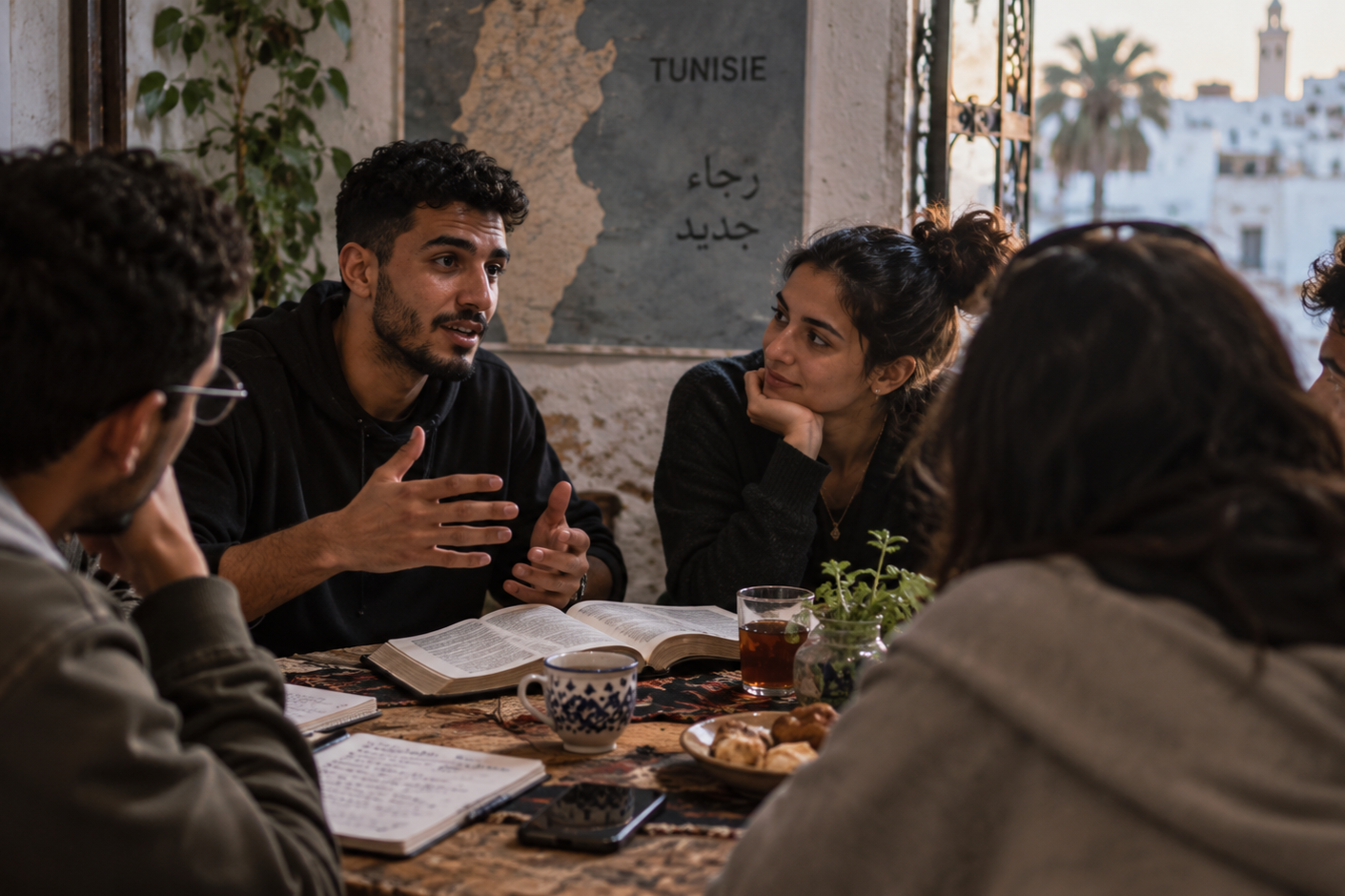
Names, locations, and images have been changed to protect the identity of individuals in sensitive regions.
On a recent visit to Tunisia, our team gathered around a table with a remarkable group of believers. Represented there were four generations of disciples—believers who had been discipled, who then discipled others, who in turn discipled others. In roughly three years, what began with a small group of leaders has multiplied through four generations of Tunisian believers.
That picture—four generations around one table—captures something at the heart of how Compel International approaches church planting.
We believe healthy movements grow as indigenous believers are equipped to obey Jesus, make disciples, raise up leaders, and entrust the gospel to others who will do the same.
“Entrust to reliable people who will also be qualified to teach others.”
From Disciples to Disciple-Makers
When someone comes to faith in Christ, we want them to understand from the beginning that following Jesus includes helping others follow Him.
They may still have many questions, but they already have relationships—with family, neighbors, coworkers, and friends—and they can begin sharing what Christ is doing in their lives.
This often leads naturally into a Discovery Bible Study, where people gather in homes to read Scripture, discover what it says, respond in obedience, and share what they are learning with others.
Sometimes that process begins directly with Scripture. In other cases, relationships form first through practical community groups or other points of connection. But the goal remains the same: people encounter the Word of God, respond to Christ, and begin making disciples themselves.
Four Generations in Three Years
That is what we are now seeing in Tunisia.
The leaders Compel initially began walking alongside discipled others. Those believers discipled another generation. And that generation has now begun discipling still others.
Four generations in roughly three years.
The significance is not simply numerical growth. It is reproducibility.
If the work depends upon Compel continually being present, leading every Bible study, directing every decision, or pastoring every emerging congregation, multiplication eventually reaches a ceiling.
But when local believers understand that they themselves have been entrusted with the gospel, the church begins to multiply from within.
The goal is not simply to make disciples. It is to make disciples who understand that they, too, have been entrusted with making disciples.
When a Bible Study Becomes a Church
As these groups grow, another question emerges:
What happens when a handful of believers meeting around Scripture begins to become a church?
Many of the believers we serve in North Africa and the Middle East come to Christ from Muslim backgrounds. Their previous experience of religious leadership often involved a sharp distinction between ordinary worshipers and highly trained religious leaders.
That assumption can follow someone into their Christian faith.
I have sat with believers who hesitated to share the Lord's Supper together because they did not believe they were qualified to do it.
They loved Christ. They were studying Scripture, sharing the gospel, and leading others toward Jesus. Yet when it came to baptism, Communion, or other basic expressions of church life, they felt someone more trained or spiritually qualified needed to do it for them.
In those moments, I take them back to Scripture.
Rediscovering the Church in Scripture
We look together at the early church.
“They devoted themselves to the apostles’ teaching and to fellowship, to the breaking of bread and to prayer.”
The first Christians gathered in homes. They prayed together, shared meals, worshiped, taught one another, broke bread, and proclaimed Christ in their communities.
For believers coming to faith in the Muslim world today, that world can feel surprisingly familiar.
These first Christians were also a minority community emerging within cultures often opposed to their faith. They did not begin with buildings, institutions, or generations of established Christian tradition.
They gathered wherever they could—often around a table in someone's home.
That does not mean biblical leadership or theological maturity are unimportant. Scripture clearly calls for mature leaders who can teach, shepherd, guard doctrine, and model Christlike character.
But biblical leadership was never intended to make ordinary believers afraid to obey Christ.
Learning to Become the Church
This becomes especially meaningful around baptism and the Lord's Supper.
I have sat with believers for whom the Communion meal we shared was the first they had ever participated in.
Some had never before been with believers in a setting where they could participate freely. Others simply did not believe they were qualified to lead the Lord's Supper themselves.
So we opened Scripture.
We talked about baptism, the Lord's Supper, and the way the early church gathered and worshiped together.
And then something important happened: they began to understand that they did not need to wait for an outside minister every time they wanted to obey Jesus.
They are the church.
They can gather again after we leave.
They can break bread, pray, study Scripture, worship Christ, baptize new believers, and teach others to obey Him.
That is when church multiplication begins to take root.
Equipping Without Controlling
This shapes the way I understand our role at Compel.
Through Discovery Bible Study, IDMM training, leadership development, prayer, encouragement, and ongoing relationship, we help equip leaders with biblical principles and reproducible ministry tools.
But our goal is not to create a Compel-controlled network of churches.
These are Tunisian believers reaching Tunisians.
They understand their communities, relationships, language, challenges, and opportunities in ways I never could.
Our role is to walk alongside them—to help them recognize biblical patterns, grow in theological understanding, develop healthy leadership, and think carefully about discipleship, church life, and multiplication.
But I do not want their confidence to rest in us.
I want it to rest in Christ, in His Word, and in the Holy Spirit who equips His church.
That requires intentional training.
It also requires releasing control.
From Training to Movement
The fruit of that approach is becoming increasingly visible across Tunisia.
Disciple-making groups are multiplying among young people and young adults. New churches have been planted. Discovery Bible Studies are meeting in multiple regions. New believers are preparing for baptism. And Tunisian leaders are now facilitating disciple-making and multiplication training themselves.
Perhaps most encouraging to me is that the work is no longer moving forward primarily through the first generation.
The second generation is discipling the third.
The third is reaching the fourth.
And increasingly, the people doing the training are the very believers who were once being trained.
What began as training has become multiplication.
What began with a few relationships is becoming a network of disciples who make disciples and churches that can give birth to other churches.
Beyond Tunisia
Now the vision is beginning to cross another boundary.
Tunisian leaders are prayerfully exploring relationships and ministry opportunities in Libya, asking God to open doors for the gospel and reveal people of peace through whom new disciple-making communities could begin.
This is what we pray multiplication will become.
Disciples make disciples.
Leaders raise up leaders.
Churches help establish churches.
And eventually, believers begin carrying the gospel beyond their own communities and borders.
We do not know everything God will do through these leaders in the years ahead.
But four generations around one table gives me reason to pray with expectation.
At one time, the first generation was being trained.
Now they are training others.
House gatherings are becoming churches.
New believers are baptizing new believers.
Christians who once wondered whether they were qualified to share the Lord's Supper are learning to gather around the table themselves and remember Christ together.
And now leaders from this young movement are looking beyond Tunisia toward places where the gospel is desperately needed.
Four generations around one table.
The gospel entrusted from one believer to another.
The church taking root in homes.
And ordinary followers of Jesus discovering that the Great Commission was entrusted to them as well.
Pray With Us
Please pray for:
Continued multiplication of disciples, leaders, and indigenous churches throughout Tunisia.
People of Peace whose homes and relationships can become gateways for the gospel.
Young believers who are learning to follow Jesus and help others discover Him.
Emerging house churches as they grow in sound doctrine, fellowship, baptism, Communion, worship, and mission.
Tunisian leaders as they train and shepherd the next generation of disciple-makers.
New believers preparing for baptism, that they would be firmly rooted in Christ and His Word.
Wisdom and protection as leaders explore new areas of Tunisia and opportunities in Western Libya.
A multiplying church that remains deeply rooted in Scripture, dependent upon the Holy Spirit, centered upon Christ, and increasingly led and reproduced by indigenous believers.
Four generations around one table is more than an encouraging ministry report.
For me, it is a glimpse of what can happen when the gospel is entrusted to faithful believers who understand that what they have received was never meant to stop with them.